
Data Science + Automation
Make Real Estate Data Actionable
-
Mitigate impact of global climate changes by preparing buildings for what’s next.
-
Predict energy use, carbon emissions, and carbon fines. Mitigate carbon risk with AI recommendations & automation.
-
Lease healthy sustainable space, automate comfortable indoor experiences.
-
Empower engineering teams with AI energy recommendations, fault detection, and automation.
-
Use the least amount energy possible to provide the maximum amount of indoor comfort.
“I have all this building data but I don’t know what to do with it…”
Quality Data + Actionable Insights = Operational Success
Data Acquisition & Trust
Our onboarding team is comprised of smart building experts who help our customers extract building data from operational technologies in the most secure and cost-effective way possible.
Data Science As A Service
Our Data Science team is comprised of building science, machine learning, and algorithm experts that help our clients clean, normalize and manage their data and design new actionable outcomes.
AI Recommendations
Nantum uses machine learning and artificial intelligence to recommend and/or automate building operations in real-time, driving energy, carbon emission, and cost savings.
Human Experience
Every customer on our platform has an assigned Real Estate Analyst and technical support lead, charged with reviewing building performance and helping customers in real-time.
Releases


Academic Papers
Large Language Model (LLM) offers opportunities to enhance Human-Building Interaction (HBI) by enabling more direct interactions through intuitive interfaces to complex smart building systems of systems. These systems can be characterized by the vast amounts of data across multiple formats, the lack of nonconfidential and generalizable information, and the requirement of domain expertise for interpretation. Applying LLMs to domain-specific tasks like HBI also presents additional challenges. Limited training data makes traditional fine-tuning approaches less practical. Meanwhile, the opacity of LLM training data requires careful integration of domain knowledge to ensure reliable responses. Additionally, different LLMs exhibit varying alignment characteristics, suggesting that achieving both natural interaction and technical accuracy requires a multi-agent approach. These challenges highlight the need for innovative approaches to adapt LLMs for specialized domains while maintaining both accuracy and user engagement. In this paper, we develop a zero-shot LLM-based multi-agent system framework for HBI that addresses these challenges, enabling scalable implementation in smart buildings through integration with real-time databases, code repositories, and technical documents. The developed framework has been successfully trained, tested, and validated using a data set from more than 200 commercial buildings. Results tested on the HBI domain demonstrate the effectiveness in providing accurate and contextual responses for diverse users including stakeholders, from tenants to building managers, across various building system applications.
This paper introduces a novel method for optimizing HVAC systems in buildings by integrating a high-fidelity physics-based simulation model with machine learning and measured data. The method enables a real-time building advisory system that provides optimized settings for condenser water loop operation, assisting building operators in decision-making. The building and its HVAC system are first modeled using eQuest. Synthetic data is then generated by running the simulation multiple times. The data are then processed, cleaned, and used to train the machine learning model. Machine learning model enables real-time optimization of the condenser water loop using particle swarm optimization. The results deliver both a real-time online optimizer and an offline operation look-up table, providing optimized condenser water temperature settings and the optimal number of cooling tower fans at a given cooling load. Potential savings are calculated by comparing measured data from two summer months with the energy costs the building would have experienced under optimized settings. Adaptive model refinement is applied to further improve accuracy and effectiveness by utilizing available measured data. The method bridge between simulation and real-time control. It has the potential to be applied to other building systems, including the chilled water loop, heating systems, ventilation systems, and other related processes. Combining physics models, data models, and measured data also enables performance analysis, tracking, and retrofit recommendations.
The US targets net-zero-carbon electricity by 2035, emphasizing the need for both supply- and demand-side strategies in the power sector. Our study focuses on demand-side carbon reduction via load regulation, using real-time greenhouse gas emission data to optimize electricity use without reducing overall consumption. Our multi-scenario analysis indicates significant potential for carbon footprint reduction by adapting strategies to specific grid characteristics. For example, California could have 32.58% more emission reduction with annual instead of quarterly optimization. In grids with diverse generation resources, expanding adjustment ranges from ±5% to ±8% can boost carbon reductions from 1.19% to 1.64%. Our results also reveal low greenhouse gas intensity fluctuation areas as more cost sensitive in electricity consumption than high greenhouse gas intensity fluctuation areas, providing essential insights for policymakers.
Measuring and benchmarking office building performance is crucial for enhancing energy efficiency, reducing environmental impact, and improving occupant productivity. Traditional Energy Use Intensity (EUI) metrics and benchmarking methods developed based on them have limitations in accounting for factors like occupancy, can hardly be explainable, and lack evolution with the advent of more real-time data. This paper introduces a set of metrics for building performance based on PeopleHour, which incorporates both the number and duration of occupancy to provide a more occupant-centric perspective on office building performance. By adjusting EUI and other related metrics to reflect building performance normalized by occupancy, we offer a more accurate measure of office building efficiency. Using sample office building data from Nantum OS, we demonstrate how PeopleHour-adjusted metrics reveal insights that traditional methods may overlook, particularly during significant occupancy changes before and after the COVID-19 pandemic. This approach emphasizes the importance of occupancy-driven operations especially as the shift of work mode and office building uses after the pandemic. It suggests that PeopleHour can enhance energy benchmarking practices, leading to more informed decisions for improving building performance across various sectors.
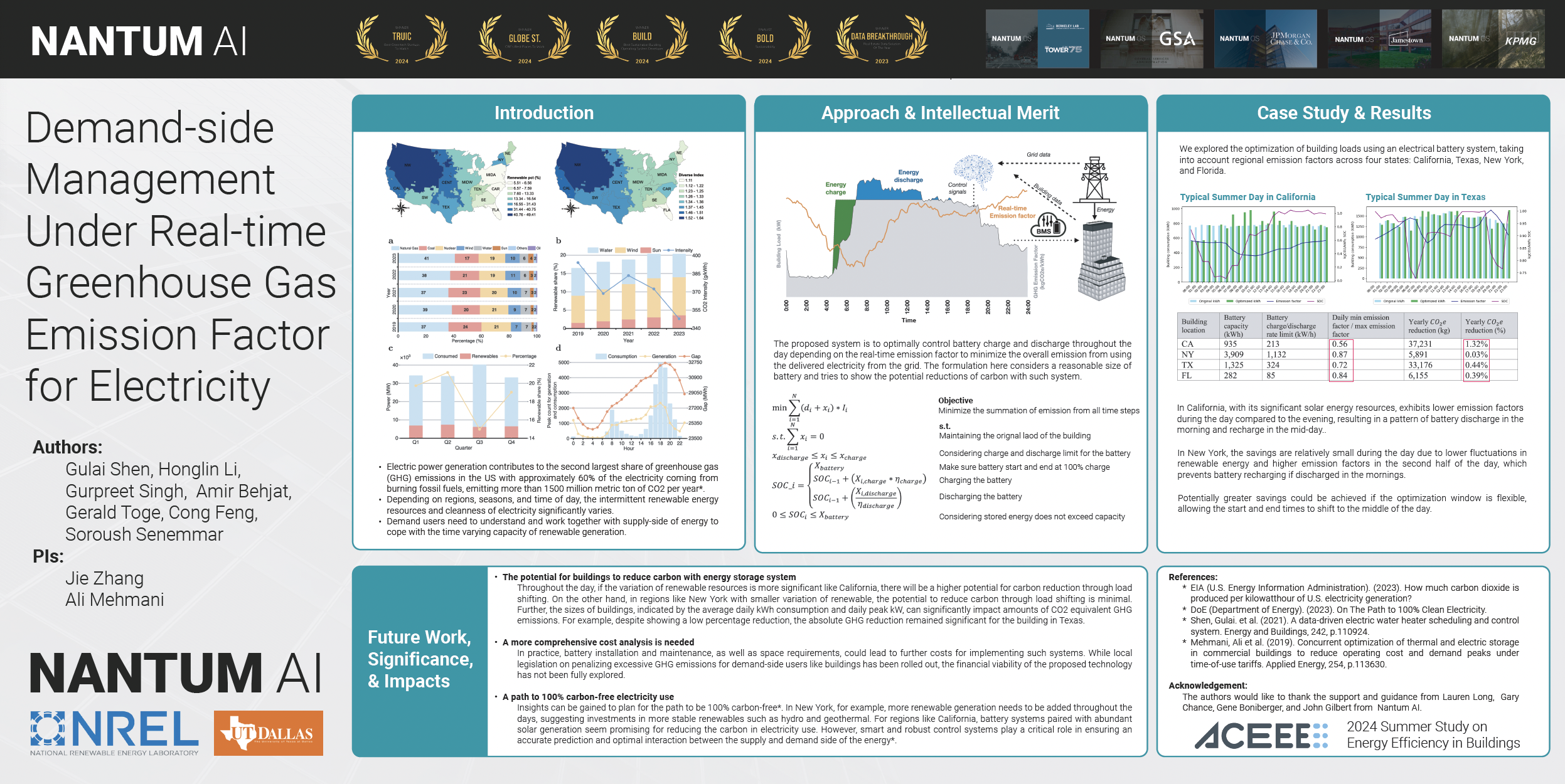
Electric power generation contributes to the second largest share of greenhouse gas (GHG) emissions in the US. The direct and indirect carbon emissions created from generating electricity vary from resources of generation, and power plant efficiency. Approximately 60% of the electricity comes from burning fossil fuels, mostly coal and natural gas, emitting more than 1500 million metric Tons of 𝐶𝑂! per year. Depending on regions and time of day, the cleanness of electricity significantly varies as more and more intermittent renewable energy resources, such as solar and wind, being added into the grid. With the growing awareness and regulations on GHG emissions, the need for accurate carbon measurement and technologies that reduces GHG for both the supply and demand side is ever-increasing. To optimally control demand-side users such as buildings, balance supply and demand, and incorporate energy storage technologies to reduce overall GHG emissions, the real-time emission factor and its predictions play critical roles. Here, we use the open-source real-time electricity GHG Emission Factor that covers all states in the US and four sample buildings’ demand data from Nantum OS across different regions to propose an optimization framework for potential emission reduction through load shifting. This study highlights the importance to raise awareness, monitor, and account for realtime GHG emissions. Furthermore, it proves the viability to control buildings with electric energy storage system to reduce carbon emissions for demand-side users.